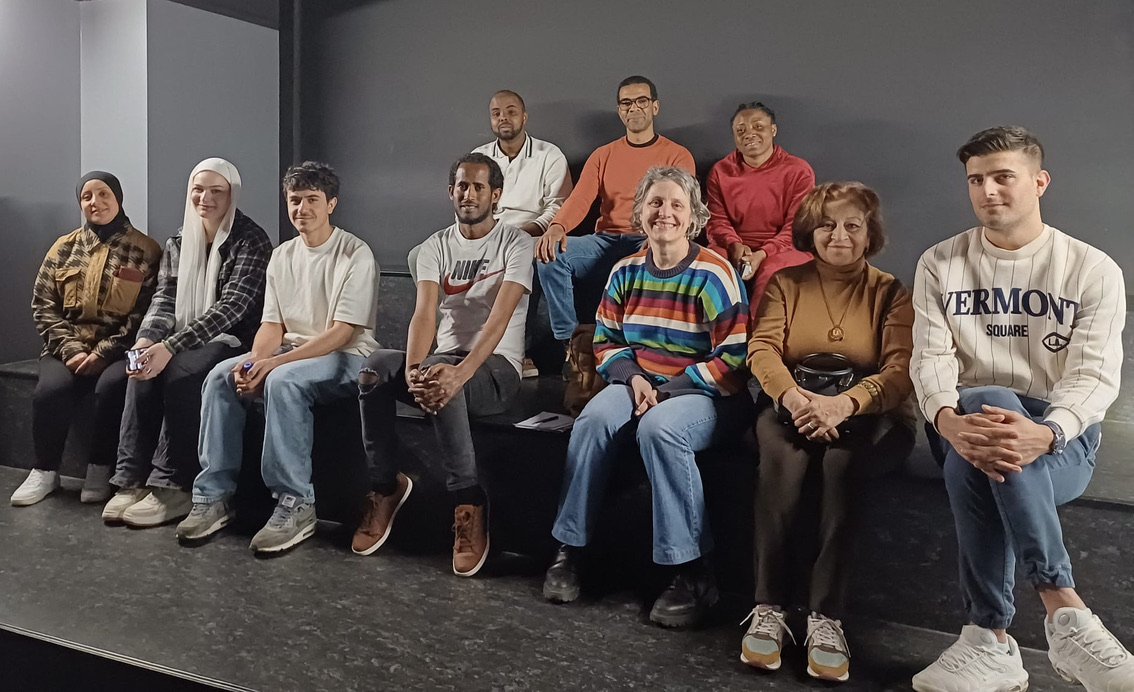
The formation Univerbal is a key project of Le Monde des Possibles, which aims to facilitate communication between professionals and non-native speakers through trained and skilled interpreters.
Due to migration flows, institutions urgently need social interpreting skills to fulfill their missions with their foreign-born audiences. As part of this training, we will work on developing your social interpreting skills in your native language and in French to structure a social interpreting service that can meet the needs and ever-increasing demand of public services in Liège.
The profession of social interpreter is one that requires training, support, and guidance before and after each interpreting session. These elements are too often overlooked, even though they enable access to information and communication for all. You will need to be familiar with the professional code of ethics, learn about the subject you will be interpreting for, and know the specific terminology related to it. All of these elements are an integral part of the training.
Univerbal training stands out for its participatory and inclusive approach, involving interpreters in project governance and the continuous improvement of practices. These professionals play a key role in building bridges between communities and essential services, thereby contributing to a more just and equitable society.
Find all the information on the website the Univerbal Formation
Find all the information on the website Services Univerbal
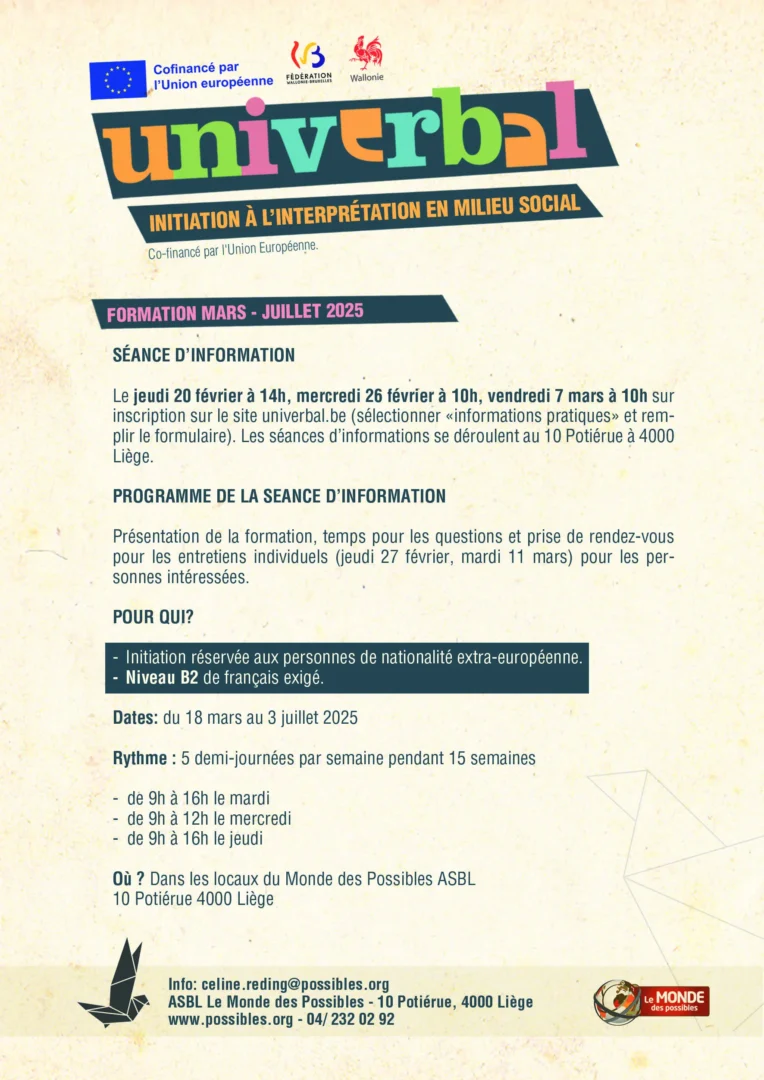
Skills / Learning Outcomes
As a future social interpreter, you will need to develop two skills specific to this profession, including the ability to interpret social interactions from one language to another and vice versa. This skill will always be put to use:
- By conveying the meaning of the message accurately and rigorously;
- Taking into account the interactional dynamics;
- By staying within the limits of his role.
You will develop this skill gradually throughout your training and professional experience.
Therefore, at the end of the Univerbal training program, we expect you to be able to interpret complex interactions for associations and public services that deal with procedures:
- Social (administrative, socio-professional, civic);
- Legal, related to immigration law;
- Medical;
- Psychological and medical.
In addition, with professional practice, you will gain confidence, particularly with regard to the critical learning initiated during training to develop the skill of “interpreting social interaction from one language to another and vice versa”:
- Realize the challenges of professionalizing the IMS profession.
- Adopt a focus on interlocutors in order to identify the elements that influence communication.
- Understanding the difference between the meaning of a statement and its literal interpretation.
- Be aware of the importance of preparing for the service.
- Adopt a multipartisan stance.
- Effectively acquire the additional specialized knowledge and language skills needed for interpreting by building a specialized terminology database called a “glossary.”
- Realize the importance of managing your emotions during and after the procedure.
Contents
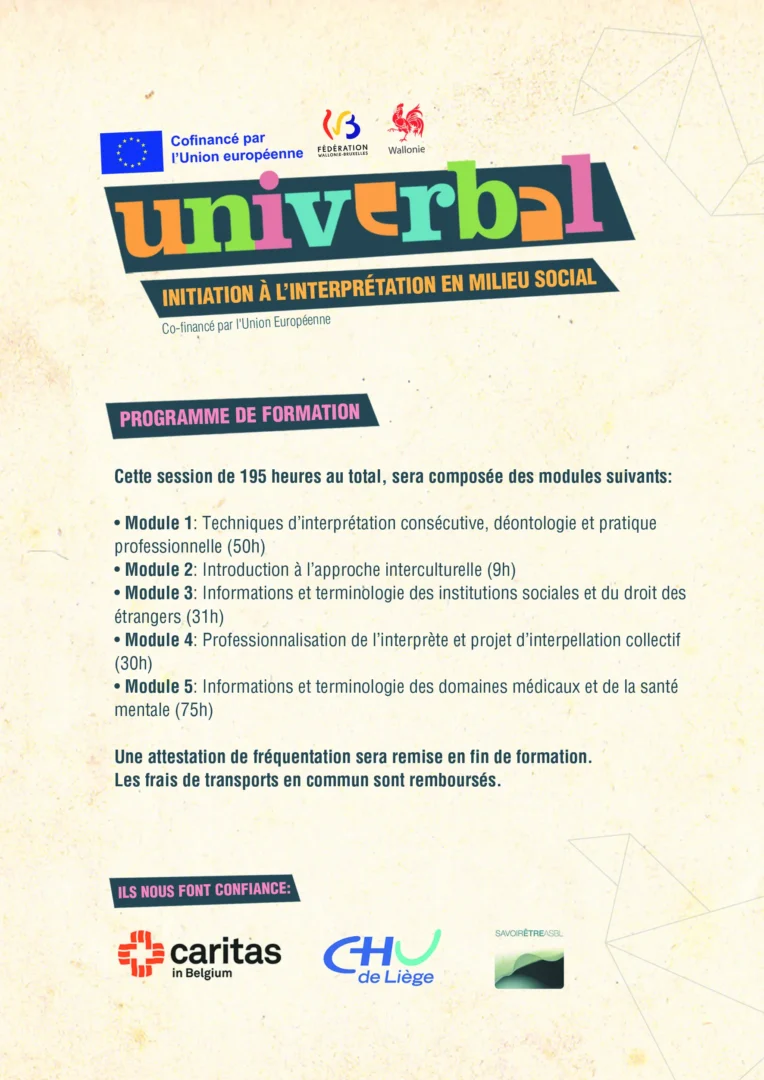
Five modules, totaling 195 hours, will provide you with the theoretical knowledge and tools you need to perform interpreting tasks in simulated (role-playing) or real-life (internships) situations:
- Module 1: Consecutive interpreting techniques, ethics, and professional practice (50 hours).
- Module 2: Introduction to the intercultural approach (9 hours).
- Module 3: Information and terminology relating to social institutions and immigration law (31 hours).
- MModule 4: Professionalization of the interpreter and collective advocacy project (30 hours).
- Module 5: Information and terminology in the medical and mental health fields (75 hours).
Observation and guidance from experienced interpreters (internship supervisors) will enable you to familiarize yourself with the profession and progress in your career.
Seminars focusing on practical issues will help you anticipate your actions, adapt your interventions, and evaluate yourself. This attitude of self-questioning, constructive self-criticism, and constructive feedback is an essential characteristic of interpreters working in social settings. These skills will be developed throughout the training program and assessed during the final evaluation.
A specific module, “Professionalization of interpreters and collective advocacy projects,” highlights Univerbal’s commitment to the social and solidarity economy. Participants are encouraged to develop collective projects such as videos, workshops, recordings, articles, or conferences.
Teaching methods
This active training program immerses you in situations similar to those you will encounter in your future profession. You will gradually be led to perform tasks, first by observing, then by practicing in role-playing exercises, and finally in real-life situations through practical internships. You will be supported by constructive feedback and ongoing self-reflection exercises.
- PHASE 1: Observation of services provided by an experienced interpreter in a real-life situation.
- PHASE 2: Performance in simulated situations (role-playing), debriefing, viewing of performances, and analysis of strengths and areas for improvement.
- PHASE 3: Supervised practical internship.
Assessment of learning
Throughout your training, you will be asked to self-assess and identify your strengths and weaknesses. To do this, you will keep a logbook and an internship journal. You will also receive feedback from your trainers, peers, and experienced interpreters, which will help you progress.
To validate your training, you will need to perform in front of a panel in a simulated situation.
| Production evaluation | Description | Production evaluation criteria |
| Role-playing games | Simulated secenario | The same assessment grid will be used throughout the training. It lists the criteria expected of you in a real or simulated interpreting situation (see grid) |
| Logbook | Critical analysis | Keeping a logbook will allow you to take a cross-sectional look at all the interpreting assignments (simulated or real) that you have completed. You will highlight your reflections, learning, and the areas on which to continue working. |
Collective interpellation project in December 2023
A collective awareness-raising project was organized in the form of information sessions on female genital mutilation, accompanied by large posters that were both artistic and informative.


Collective interpellation project in May 2024 on elections
In May 2024, a collective outreach project was carried out, including sessions interpreted into several languages to inform participants about the elections, the different levels of government in Belgium, and the main political parties.

Project UniSonous :
The UniSonous project has produced multilingual recordings dedicated to LGBTQIA+ issues, with the aim of raising awareness, informing, and promoting the inclusion of LGBTQIA+ migrants.
Russian:
Albanian:
Spanish:
Kignarwanda :
Pachtou :
Portuguese:
French :